WHAT YOU’LL FIND IN THIS COLLECTION
-
2-pack: a focused starting point for mapping two bass drum spur positions.
-
4-pack: extra anchors for the floor contact points that move beyond the bass drum.
-
16-pack: a broader position map for touring rigs, wider setups, and repeatable backline.
-
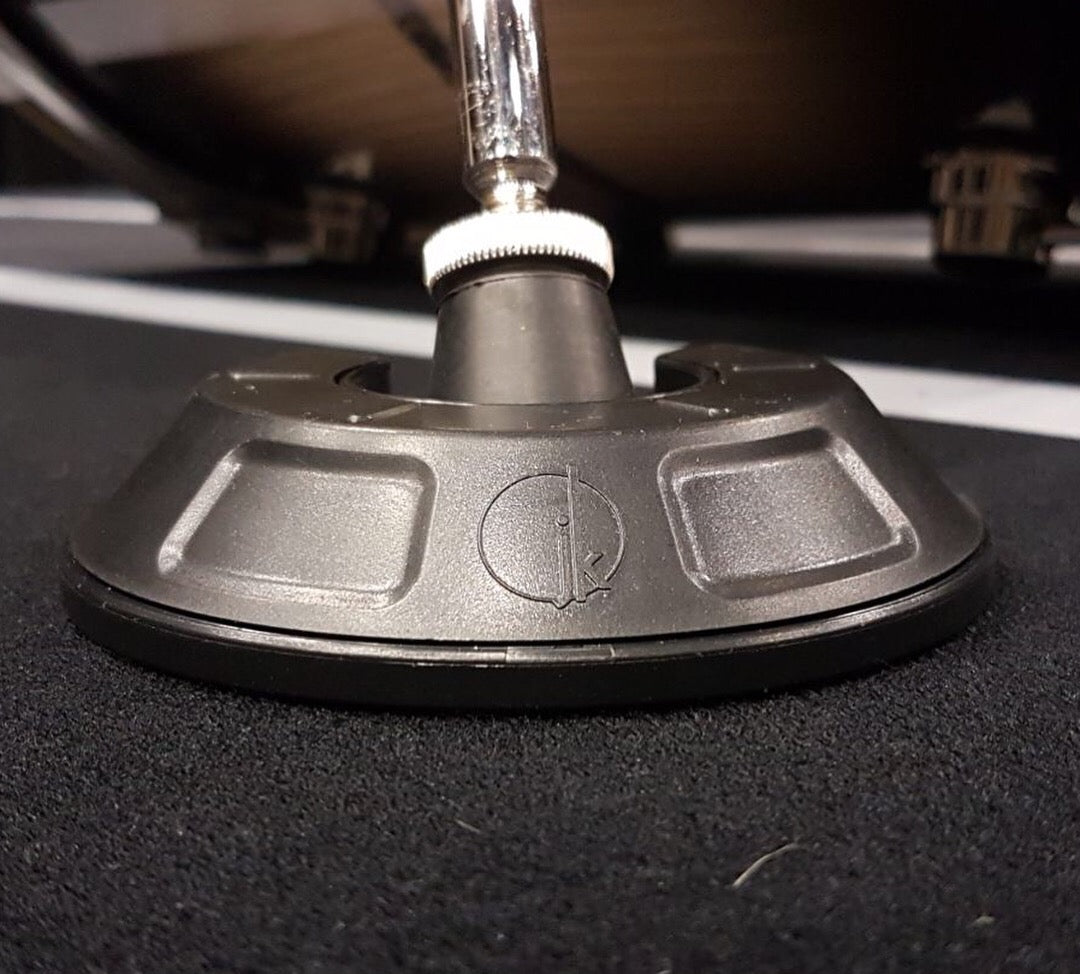
Floor-contact capture: Hooves work around spurs, hardware feet, pedal bases, and rack legs instead of pressing against the bass drum hoop.
-
Hook Velcro underside: designed to grip into a tight-knit rug or carpet system that accepts hook Velcro.
-
Repeatable placement: leave the Hooves on the compatible rug, then return the kit to the same footprint at the next setup.
HOW TO CHOOSE THE RIGHT BASS DRUM ANCHOR OPTION
Choose your pack by counting the floor contact points that need a fixed position. The aim is not to anchor every item in sight. It is to map the points that actually move during setup or playing.
-
Start with the bass drum: A 2-pack gives both bass drum spurs defined positions on a compatible rug. It is the logical first step when bass drum creep is the main issue.
-
Add pedal or stand positions: Choose a 4-pack if your front-line hardware also shifts. Identify the pedal base or stand foot that moves, then add anchors where they make a difference.
-
Map a larger touring footprint: A 16-pack suits larger kits with more pedals, stands, or rack legs, especially where a tech needs to recreate the same layout show after show.
-
Check the surface: JK Hooves are designed for a tight-knit, Velcro-compatible drum rug or carpet system. They are not intended to grip directly to bare wood, concrete, or a smooth riser.
-
Plan for changeovers: If setup time matters, leave the Hooves in their mapped positions on the rug. The hardware then has a clear place to return to.
JK Hooves are not a hoop-bracing kick drum stopper. They are a capture-style bass drum stabilizer that defines the floor contact points for your bass drum and other moving hardware.
COMMON PROBLEMS AND HOW TO FIX THEM
My bass drum keeps sliding forward during the set
Start with the rug. It needs to be tight-knit and compatible with hook Velcro. Next, place one Hoove at each bass drum spur, set the drum where it feels right, and test the setup with your normal playing intensity. If movement continues, inspect whether pedals or other hardware are pushing the drum out of position. See how to stop your bass drum from sliding for a fuller troubleshooting flow.
I want to buy JK Hooves for my touring rig. How many do I need?
Begin with the contact points that need to stay defined. Choose a 2-pack for the two bass drum spurs. Move to a 4-pack if a pedal base or stand also drifts. For a wider touring setup with multiple pieces of hardware and a repeatable backline footprint, choose a 16-pack. Build the map around your real setup, not an imaginary perfect kit.
My pedals move after I lock the bass drum
Anchoring the bass drum does not automatically secure every pedal. Find the pedal base or stand foot that is changing position and add a Hoove at that contact point. This modular approach lets you expand only where your setup needs more definition.
My double pedal setup keeps shifting sideways
Set the bass drum spurs first, then check whether the pedal assembly moves independently on the rug. Add Hooves only at the contact points that drift. Test the whole arrangement before a gig so the placement feels familiar when it counts.
Will JK Hooves work on any stage surface?
No. JK Hooves need a tight-knit rug or carpet system that accepts hook Velcro. A smooth stage floor does not provide the compatible base the hook surface requires. The surface, rug material, and spur setup all affect movement. Read why bass drums creep to understand the role each one plays.
Is JK Hooves the same as a KickBlock?
No. A KickBlock-style product generally braces against the bass drum hoop to help limit forward movement. JK Hooves capture spurs and hardware feet at the floor. That makes them useful for creating a wider position map that can include pedals, stands, and rack legs, not only the bass drum.
WHY THIS WORKS ON REAL STAGES
Real stages are rarely identical. Rugs change, load-ins run late, and the placement that felt right at soundcheck can become a distraction halfway through a set. JK Hooves support a practical touring workflow: define the positions on a compatible rug once, then return each piece of hardware to that map at the next setup. That helps a drummer preserve a familiar feel and gives a backliner a clearer footprint to recreate.
JK Drum Systems products are used by world-touring artists and productions including Metallica, Lady Gaga, Katy Perry, and Slipknot. That is the environment Hooves are built for: repeatable hardware placement when stage time, changeovers, and consistency matter.
JK Hooves have also been featured by Modern Drummer. The product is not a miracle cure for every stage condition. It is a straightforward way to capture key hardware contact points and repeat a working layout from venue to venue.
FAQ
What is a bass drum anchor?
A bass drum anchor is an accessory that helps keep a bass drum in a defined position while playing. JK Hooves do this by capturing the drum’s spurs at floor contact points on a compatible rug, rather than pressing against the hoop.
What is the difference between a bass drum anchor and a kick drum stopper?
Both address bass drum movement. A kick drum stopper often describes a barrier-style product placed against the hoop. JK Hooves are a kick drum anchor system that captures spurs and hardware feet on a compatible rug.
Do I need one Hoove for each bass drum spur?
For a defined bass drum position, use one Hoove for each spur. This gives both contact points a mapped location on the rug and supports a more consistent placement from setup to setup.
Does KickBlock work?
KickBlock-style products and JK Hooves address related problems in different ways. A hoop-bracing stopper may suit a drummer focused only on forward bass drum movement. Hooves suit players and techs who want to define floor-contact positions across more of the kit.
Can I use JK Hooves for pedals and stands?
JK Hooves are designed to capture more than bass drum spurs. Add them where a pedal base, hardware foot, or rack leg moves on your compatible drum rug. Select the pack size based on the number of positions you want to define.
Why does my bass drum creep even when I use a rug?
A rug alone may not provide a fixed position map. Rug material, playing force, spur setup, and moving pedals can all contribute. JK Hooves require a tight-knit rug that accepts hook Velcro to capture the contact points.
Why do drummers put a hole in the bass drum head?
A hole in the resonant bass drum head is generally used for microphone access and airflow. It does not prevent bass drum creep. For movement problems, focus on the spurs, the rug, and the floor contact points.
Where can I compare different kick drum anchor types?
Read the kick drum anchor guide for a practical comparison of hoop-bracing, strap-based, and floor-contact capture approaches.
If your kit needs to land in the same place every night, begin with the contact points that move most. Browse the JK Hooves collection, choose the pack that fits your footprint, and use it with a tight-knit, Velcro-compatible drum rug or carpet system.